
Sachin Tendulkar was born April 24, 1973 in Bombay, India.
Given his first cricket bat at the age 11, Tendulkar was just 16 when he
became India's youngest Test cricketer. In 2005 he became the first
cricketer to score 35 centuries (100 runs in a single inning) in Test
play. In 2007 Tendulkar reached another major milestone, becoming the
first player to record 15,000 runs in one-day international play.
Professional cricket player. Largely considered cricket's
greatest batsman, Sachin Tendulkar was born April 24, 1973 in Bombay,
India, to a middle-class family, the youngest of four children. His
father was a professor while his mother worked for a life insurance
company.
Named after his family's favorite music director, Sachin Dev Burman,
Tendulkar wasn't a particularly gifted student, but he'd always shown
himself to be a standout athlete. He was 11 years old when he was given
his first cricket bat and his talent in the sport was immediately
apparent. At the age of 14 he scored 329 out of a world record stand of
664 in a school match. As his accomplishments grew, he became a sort of
cult figure among Bombay schoolboys.
After high school Tendulkar enrolled at Kirti College, where his
father also taught. The fact that he decided to go to the school where
his father worked was of no surprise. Tendulkar's family is very close
and years after he'd achieved stardom and cricket fame, he continued to
live next door to his parents.
Tendulkar made his debut in international competition at 16
with a match against Pakistan in Karachi. He wasted little time matching
the expectations surrounding his arrival on the professional field. At
the age of 18 he scored a pair of centuries in Australia, then in 1994
racked up a score of 179 in a match against the West Indies.
Tendulkar was just 23 when he was named captain of his country's team
for the 1996 World Cup. While the tournament proved to be a
disappointment for his club, Tendulkar did nothing to diminish his own
standing as one of the world's dominant players. He finished out the
World Cup as the event's top scorer.
In India, Tendulkar's star shined even brighter. In a country reeling
from troubled economic times, the young cricketer was seen as a symbol
of hope by his countrymen that better times lay ahead. On national
newsweekly went so far as to devote an entire issue to the young
cricketer, dubbing him "The Last Hero" for his home country. His style
of play—aggressive and inventive—resonated with the sport's fans, as did
Tendulkar's unassuming off the field living. Even with his increasing
wealth, Tendulkar showed humility and refused to flaunt his money.
Tendulkar's dominance of his sport has continued, even as he's moved
well into his thirties. He scored his record-breaking 35th century in
Test play in December 2005 in a match against Sri Lanka. In June 2007 he
set another mark when he became the first player to record 15,000 runs
in one-day international play. In January 2010 he again moved into the
record books when became the first batsman to score 13,000 runs in Test
play.
Sachin Tendulkar
- 24 April 1973 (age 39)
-
Bombay (now Mumbai), Maharashtra , India
|
- Tendlya, Little Master,[1] God of Cricket [2]
|
- International information
|
|---|
- Domestic team information
|
|---|
Sachin Ramesh Tendulkar English pronunciation: /səˈtʃɪn tɛnˈduːlkər/ ( listen) AM
 (born 24 April 1973)
[1] is an
Indian cricketer widely acknowledged as the greatest living
batsman, and second only to
Don Bradman[3]
in the all time greatest list in Test. In ODIs, however, statistics
confirm that Sachin is by far the most successful one-day batsman in
history. In 2002, just 12 years into his career,
Wisden
ranked him the second greatest Test batsman of all time, behind
Bradman, and the second greatest one-day-international (ODI) batsman of
all time, behind
Viv Richards.
[4] Tendulkar was a part of the
2011 Cricket World Cup winning
Indian team in the later part of his career, his first such win in six World Cup appearances for India.
[5] He was also the recipient of Player of the Tournament award of
ICC World Cup, 2003 held in South Africa.
He won the 2010
Sir Garfield Sobers Trophy for cricketer of the year at the ICC awards.
[6] He has been recommended for the receipt of the
Bharat Ratna award, in fact it has been speculated that the criteria for the award of the
Bharat Ratna was changed to allow him receive the award.
[7][8] He is also a member of
Rajya Sabha of
Parliament of India.
[9]
Tendulkar passed 30,000 runs in international cricket on 20 November
2009. After a two-month break he is likely to return to test arena with
the series against New Zealand commencing in late August 2012.
[10] On 5 December 2012,Sachin Tendulkar became first batsman in history to complete 34,000 runs in (ODIs+Tests+T20Is).
[11][12][13] He has till now played 657 matches in international cricket.
[14]
Tendulkar has been honoured with the
Padma Vibhushan award, India's second highest civilian award, and the
Rajiv Gandhi Khel Ratna award, India's highest sporting honour.
[citation needed] Tendulkar became the first sportsperson and the first person without an aviation background to be awarded the honorary rank of
Group Captain by the
Indian Air Force. He has received honorary doctorates from
University of Mysore[15] and
Rajiv Gandhi University of Health Sciences[16] Sachin holds the 18th rank in
ICC Player Rankings for Test batsmen as of 4 December 2012.
[17] On 1 August 2012, Sachin Tendulkar was nominated for the ICC People's Choice award for the third time.
[18] In 2012, he was nominated to
Rajya Sabha, the upper house of the
Parliament of India.
Sachin Tendulkar was conferred with the membership in the Order of
Australia (AM) in Mumbai on 6 November 2012. Simon Crean, minister in
the Australian cabinet, presented the award to Tendulkar.
[19]
Julia Gillard, the Australian Prime Minister, was on an official visit
to New Delhi in October and had announced Tendulkar's name as the latest
recipient of the award.
Early years and personal life
Tendulkar was born on 24 April 1973 into a
Rajapur Saraswat Brahmin family in Bombay (now
Mumbai).
[20][21][22] His father Ramesh Tendulkar was a reputed
Marathi novelist and his mother Rajni worked in the insurance industry.
[23] Ramesh named Tendulkar after his favourite music director,
Sachin Dev Burman.
Tendulkar has three elder siblings: two half-brothers Nitin and Ajit,
and a half-sister Savita. They were Ramesh's children from his first
marriage.
[24] He spent his formative years in the
Sahitya Sahawas Cooperative Housing Society,
Bandra (East), Bombay. As a young boy, Tendulkar was considered a bully, and often picked up fights with new children in his school.
[25] He also showed an interest in
tennis, idolising
John McEnroe.
[26]
To help curb his mischievous and bullying tendencies, Ajit introduced
him to cricket in 1984. He introduced the young Sachin to
Ramakant Achrekar, a famous cricket coach of Bombay and a club cricketer of repute, at
Shivaji Park,
Dadar, Bombay.
Achrekar was impressed with Tendulkar's talent and advised him to
shift his schooling to Sharadashram Vidyamandir (English) High School,
[1] a school at Dadar which had a dominant cricket team and had produced many notable cricketers.
[27] Prior to this, Tendulkar had attended the Indian Education Society's New English School in Bandra (East).
[27] He was also coached under the guidance of Achrekar at Shivaji Park in the mornings and evenings.
[28] Tendulkar would practice for hours on end in the nets. If he became exhausted, Achrekar would put a one-
rupee coin on the top of the
stumps,
and the bowler who dismissed Tendulkar would get the coin. If Tendulkar
passed the whole session without getting dismissed, the coach would
give him the coin. Tendulkar now considers the 13 coins he won then as
some of his most prized possessions.
[29] He moved in with his aunt and uncle, who lived near Shivaji Park, during this period, due to his hectic schedule.
[27]
Meanwhile at school, he developed a reputation as a child prodigy. He
had become a common conversation point in Mumbai cricketing circles,
where there were suggestions already that he would become one of the
greats. Besides school cricket, he also played club cricket, initially
representing John Bright Cricket Club in Bombay's premier club cricket
tournament, the Kanga League,
[27] and later went on to play for the
Cricket Club of India.
[30] In 1987, at the age of 14, he attended the
MRF Pace Foundation in Madras (now
Chennai) to train as a
fast bowler, but Australian fast bowler
Dennis Lillee, who took a world record 355 Test wickets, was unimpressed, suggesting that Tendulkar focus on his batting instead.
[31] A couple of months later, former Indian batsman
Sunil Gavaskar
gave him a pair of his own ultra light pads. "It was the greatest
source of encouragement for me," Tendulkar said nearly 20 years later
after surpassing Gavaskar's world record of 34 Test centuries.
[32]
His season in 1988 was extraordinary, with Tendulkar scoring a century
in every innings he played. He was involved in an unbroken 664-run
partnership in a Lord Harris Shield inter-school game against Anjuman-E-Islam High School in 1988 with his friend and team-mate
Vinod Kambli,
who would also go on to represent India. The destructive pair reduced
one bowler to tears and made the rest of the opposition unwilling to
continue the game. Tendulkar scored 326 (not out) in this innings and
scored over a thousand runs in the tournament.
[33] This was a record partnership in any form of cricket until 2006, when it was broken by two under-13 batsmen in a match held at
Hyderabad in India.
On 24 May 1995,
[34] at the age of 22, Tendulkar married Anjali, a
paediatrician and daughter of
Gujarati industrialist Anand Mehta and British social worker Annabel Mehta. Anjali is six years his senior.
[35]
They have two children, Sara (born 12 October 1997) and Arjun (born 24
September 1999). Arjun, a left handed batsman, has recently been
included in under-14 probables list of Mumbai Cricket Association for
off-season training camp.
[36][relevant? – discuss]
Beliefs
Tendulkar is known to be a religious person,
[37] and an ardent devotee of
Sathya Sai Baba of Puttaparthi.
[38][39][40] He has visited Puttaparthi on several occasions to seek Baba's blessings.
[38][41]
In 1997, Tendulkar captained the Indian National side, playing against a
World Eleven team, in the Unity Cup which was held at the hill view
stadium in Puttaparthi, in Baba's presence.
[42][43]
After Sai Baba's death, Tendulkar broke into tears when he saw the body
of Baba in Puttaparthi, and cancelled his birthday celebrations.
[44][45][46]
The cricketer is also known to celebrate Ganesh Chaturthi at home and
frequently visits temples during night when it is calm and quiet.
[37][47] The cricketer has also offered his prayers at several other
Hindu temples across the country.
[48][49]
Early domestic career
On 14 November 1987, Tendulkar was selected to represent
Bombay in the
Ranji Trophy, India's premier domestic
first-class cricket tournament, for the 1987–88 season. However, he was not selected for the final eleven in any of the matches.
[27] A year later, on 11 December 1988, aged just 15 years and 232 days, Tendulkar made his debut for Bombay against
Gujarat
at home and scored 100 not out in that match, making him the youngest
Indian to score a century on first-class debut. He was handpicked to
play for the team by the then Mumbai captain
Dilip Vengsarkar after watching him easily negotiating India's best fast bowler at the time,
Kapil Dev, in the
Wankhede Stadium nets,
[1] where the
Indian team had come to play against the touring
New Zealand team. He followed this by scoring a century in his first Deodhar and Duleep Trophies, which are also Indian domestic tournaments.
[50]
Tendulkar finished the 1988–89 season as Bombay's highest run-scorer.
[note 1][51] He also made an unbeaten century in the
Irani Trophy match against
Delhi at the start of the 1989–90 season, playing for the Rest of India.
[52]
In 1992, at the age of 19, Tendulkar became the first overseas-born player to represent
Yorkshire, which prior to Tendulkar joining the team, never selected players even from other English counties.
[1][note 2] Selected for Yorkshire as a replacement for the injured
Australian fast bowler
Craig McDermott, Tendulkar played 16 first-class matches for the county and scored 1070 runs at an average of 46.52.
[53]
His first double century was for Mumbai while playing against the visiting Australian team at the
Brabourne Stadium in 1998.
[1] He is the only player to score a century in all three of his domestic first-class debuts.
[54]
International career
Early career
Raj Singh Dungarpur is credited for the selection of Tendulkar for the Indian tour of
Pakistan in late 1989,
[55] and that also after just one first class season.
[56] The Indian selection committee had shown interest in selecting Tendulkar for the tour of the
West Indies
held earlier that year, but eventually did not select him, as they did
not want him to be exposed to the dominant fast bowlers of the West
Indies so early in his career. Tendulkar made his
Test debut against Pakistan in
Karachi in November 1989 aged just 16 years and 223 days. He made just 15 runs, being bowled by
Waqar Younis,
who also made his debut in that match, but was noted for how he handled
numerous blows to his body at the hands of the Pakistani pace attack.
[57] In the fourth and final test in
Sialkot, he was hit on the nose by a bouncer bowled by
Imran Khan, but he declined medical assistance and continued to bat even as he gushed blood from it.
[58] In a 20 over exhibition game in
Peshawar,
held in parallel with the bilateral series, Tendulkar made 53 runs off
18 balls, including an over in which he scored 27 runs off leg-spinner
Abdul Qadir.
[note 3] This was later called "one of the best innings I have seen" by the then Indian captain
Krishnamachari Srikkanth.
[59] In all, he scored 215 runs at an average of 35.83 in the Test series, and was dismissed without scoring a run in the only
One Day International (ODI) he played.
[60][61]
The series was followed by a tour of New Zealand in which he scored
117 runs at an average of 29.25 in, Tests including an innings of 88 in
the Second Test.
[62] He was dismissed without scoring in one of the two one-day games he played, and scored 36 in the other.
[63]
On his next tour, to England in July/August 1990, he became the second
youngest cricketer to score a Test century as he made 119 not out at
Old Trafford in
Manchester.
[58] Wisden described his innings as "a disciplined display of immense maturity" and also wrote:
[64]
"He looked the embodiment of India's famous opener,
Gavaskar, and indeed was wearing a pair of his pads. While he displayed
a full repertoire of strokes in compiling his maiden Test hundred, most
remarkable were his off-side shots from the back foot. Though only 5ft
5in tall, he was still able to control without difficulty short
deliveries from the English pacemen."
Tendulkar further enhanced his development during the 1991–1992 tour of Australia held before the
1992 Cricket World Cup, that included an unbeaten 148 in
Sydney and 114 on a fast, bouncing pitch at
Perth against a world-class pace attack comprising
Merv Hughes,
Bruce Reid and Craig McDermott. Hughes commented to
Allan Border at the time that "This little prick's going to get more runs than you, AB."
[65]
Rise through the ranks
Tendulkar's performance through the years 1994–1999 coincided with his physical peak, in his early twenties. On the day of the
Hindu festival
Holi, Tendulkar was told to open the batting at
Auckland against New Zealand in 1994.
[66] He went on to make 82 runs off 49 balls. He scored his first ODI century on 9 September 1994 against Australia in
Sri Lanka at
Colombo. It had taken him 79 ODIs to score a century.


Tendulkar waits at the bowler's end.
Tendulkar's rise continued when he was the leading run scorer at the
1996 World Cup, scoring two centuries.
[67]
He was the only Indian batsman to perform in the infamous semi-final
against Sri Lanka. Tendulkar fell amid a batting collapse and the match
referee,
Clive Lloyd awarded Sri Lanka the match after the crowd began rioting and throwing litter onto the field.
After the World Cup, in the same year against Pakistan at
Sharjah, Indian captain
Mohammed Azharuddin was going through a lean patch. Tendulkar and
Navjot Singh Sidhu
both made centuries to set a then record partnership for the second
wicket. After getting out, Tendulkar found Azharuddin in two minds about
whether he should bat. Tendulkar convinced Azharuddin to bat and
Azharuddin subsequently unleashed 29 runs in a mere 10 balls. It enabled
India post a score in excess of 300 runs for the first time in an ODI.
India went on to win that match.
This was the beginning of a period at the top of the batting world,
culminating in the Australian tour of India in early 1998, with
Tendulkar scoring three consecutive centuries. These were characterised
by a premeditated plan to target Australian spinners
Shane Warne and
Gavin Robertson,
to whom he regularly charged down the pitch to drive over the infield.
This technique worked as India beat Australia. The test match success
was followed by two scintillating knocks in a
tournament
in Sharjah where he scored two consecutive centuries in a must-win game
and then in finals against Australia tormenting Shane Warne once again.
Following the series Warne ruefully joked that he was having nightmares
about his Indian nemesis.
[68]
He also had a role with the ball in that series, including a five
wicket haul in an ODI. Set 310 runs to win, Australia were cruising
comfortably at 203 for 3 in the 31st over when Tendulkar turned the
match for India taking wickets of
Michael Bevan,
Steve Waugh,
Darren Lehmann,
Tom Moody and
Damien Martyn for just 32 runs in 10 overs.
[69]
Tendulkar single-handedly won the ICC 1998 quarterfinal at
Dhaka
to pave way for India's entry into the semifinals, when he took four
Australian wickets after scoring 141 runs in just 128 balls.
The inaugural
Asian Test Championship took place in February and March 1999. Held just twice, the
1999 championship was contested by India, Pakistan, and Sri Lanka.
[70] Eden Gardens hosted the first match, in which Tendulkar was run out for nine after colliding with Pakistan bowler
Shoaib Akhtar.
The crowd's reaction to the dismissal was to throw objects at Akhtar,
and the players were taken off the field. The match resumed after
Tendulkar and the president of the ICC appealed to the crowd, however
further rioting meant that the match was finished in front of a crowd of
just 200 people.
[71] Tendulkar scored his 19th Test century in the second Test and the match resulted in a draw with Sri Lanka.
[72]
India did not progress to the final, which was won by Pakistan, and
refused to participate the next time the championship was held to
increasing political tensions between India and Pakistan.
[73]
A chronic back problem flared up when Pakistan toured India in 1999, with India losing the historic Test at
Chepauk
despite a gritty century from Tendulkar himself. The worst was yet to
come as Professor Ramesh Tendulkar, Tendulkar's father, died in the
middle of the
1999 Cricket World Cup. Tendulkar flew back to India to attend the final rituals of his father, missing the match against
Zimbabwe.
However, he returned with a bang to the World cup scoring a century
(unbeaten 140 off 101 balls) in his very next match against
Kenya in Bristol. He dedicated this century to his father.
[74]
Captaincy
- Tendulkar's record as captain
|
|---|
Tendulkar's two tenures as captain of the Indian cricket team were
not very successful. When Tendulkar took over as captain in 1996, it was
with huge hopes and expectations. However, by 1997 the team was
performing poorly.
Azharuddin was credited with saying
"Nahin jeetega! Chote ki naseeb main jeet nahin hai!",
[77] which translates into: "He won't win! It's not in the small one's destiny!".
[78]
Tendulkar, succeeding Azharuddin as captain for his second term, then
led India on a tour of Australia, where the visitors were
comprehensively beaten 3–0 by the newly crowned world champions.
[79]
Tendulkar, however, won the player of the tournament award as well as
player of the match in one of the games. After another Test series
defeat, this time by a 0–2 margin at home against South Africa,
Tendulkar resigned, and
Sourav Ganguly took over as captain in 2000.
Tendulkar remains an integral part of the Indian team's strategic
processes. He is often seen in discussion with the captain, at times
actively involved in building strategies. Former captain
Rahul Dravid publicly acknowledged that Tendulkar had been suggesting moves such as the promotion of
Irfan Pathan
up the batting order which, although only temporary, had an immediate
effect on the team's fortunes. In 2007, Tendulkar was appointed
vice-captain to captain Rahul Dravid.
[80] During the Indian team's 2007 tour of England, Dravid's desire to resign from the captaincy became known. The BCCI President
Sharad Pawar personally offered the captaincy to Tendulkar.
[80] However, Tendulkar asked Pawar not to appoint him captain, instead recommending
Mahendra Singh Dhoni to take over the reins.
[80]
Pawar later revealed this conversation, crediting Tendulkar for first
forwarding the name of Dhoni, who since achieved much success as
captain.
[80]
Injuries and apparent decline
Sachin Tendulkar continued performing well in Test cricket in 2001
and 2002, with some pivotal performances with both bat and ball.
Tendulkar took three wickets on the final day of the famous
Kolkata Test against Australia in 2001. Tendulkar took the key wickets of
Matthew Hayden and
Adam Gilchrist, centurions in the previous test.
In the 2002 series in the West Indies, Tendulkar started well,
scoring 79 in the first test, and 117 in the first innings of the
second. Then, in a hitherto unprecedented sequence, he scored 0, 0, 8
and 0 in the next four innings, getting out to technical "defects" and
uncharacteristically poor strokes. He returned to form in the last test
scoring 41 and 86. However, India lost the series. This might have been
the beginning of the "decline" phase in his career which lasted till
2006.
Tendulkar made 673 runs in 11 matches in the
2003 Cricket World Cup,
helping India reach the final. While Australia retained the trophy that
they had won in 1999, Tendulkar was given the Man of the Tournament
award.
He continued to score heavily in ODI cricket that year, with two hundreds in a tri series involving New Zealand and Australia.
The drawn series as India toured Australia in 2003/04 saw Tendulkar
making his mark in the last Test of the series, with 241 not out in
Sydney,
putting India in a virtually unbeatable position. He followed up the
innings with an unbeaten 60 in the second innings of the test. Prior to
this test match, he had had an unusually horrible run of form, failing
in all six innings in the preceding three tests. It was no aberration
that 2003 was his worst year in test cricket, with an average of 17.25
and just one fifty.
Tendulkar scored an unbeaten 194 against Pakistan at
Multan
in the following series. India declared before Tendulkar reached 200;
had he done so it would have been the fourth time he passed the landmark
in Tests.
[81]
In meeting with the press that evening, Tendulkar stated that he was
disappointed and that the declaration had taken him by surprise.
[82] Many former cricketers commented that Dravid's declaration was in bad taste.
[83][84] After India won the match, the captain Rahul Dravid stated that the matter was spoken internally and put to rest.
[85]
Tennis elbow then took its toll on Tendulkar, leaving him out of the
side for most of the year, coming back only for the last two tests when
Australia
toured India in 2004. He played a part in India's victory in Mumbai in
that series with a fast 55, though Australia took the series 2–1.
On 10 December 2005 at
Feroz Shah Kotla, Tendulkar scored his record-breaking 35th Test century, against the
Sri Lankans.
After this, Tendulkar endured the longest spell of his career without a
Test century: 17 innings elapsed before he scored 101 against
Bangladesh in May 2007.
[86]
Tendulkar scored his 39th ODI hundred on 6 February 2006 in a match
against Pakistan. He followed with a run-a-ball 42 in the second one-day
international against Pakistan on 11 February 2006, and then a 95 in
hostile, seaming conditions on 13 February 2006 in Lahore, which set up
an Indian victory. On 19 March 2006, after scoring an unconvincing 1 off
21 balls against
England in the first innings of the third Test in his home ground,
Wankhede, Tendulkar was booed off the ground by a section of the crowd,
[87]
the first time that he had ever faced such flak. Tendulkar was to end
the three-Test series without a single half-century to his credit, and
news of a shoulder operation raised more questions about his longevity.
In July 2006, the
Board of Control for Cricket in India
(BCCI) announced that Tendulkar had overcome his injury problem
following an operation and rehabilitation programme and was available
for selection, and he was eventually selected for the next series.
Tendulkar's comeback came in the DLF cup in
Malaysia
and he was the only Indian batsman to shine. In his comeback match,
against West Indies on 14 September 2006, Tendulkar responded to his
critics who believed that his career was inexorably sliding with his
40th ODI century. Though he scored 141 not out, West Indies won the
rain-affected match by the
D/L method.
During the preparation for the
2007 World Cup, Tendulkar was criticised by
Greg Chappell on his attitude.
[88]
As per the report, Chappell felt that Tendulkar would be more useful
down the order, while the latter felt that he would be better off
opening the innings, the role he had played for most of his career.
Chappell also believed that Tendulkar's repeated failures were hurting
the team's chances. In a rare show of emotion, Tendulkar hit out at the
comments attributed to Chappell by pointing out that no coach has ever
suggested his attitude towards cricket is incorrect. On 7 April 2007,
the Board of Control for Cricket in India issued a notice to Tendulkar
asking for an explanation for his comments made to the media.
[89]
At the World Cup in the West Indies, Tendulkar and the Indian cricket
team, led by Rahul Dravid had a dismal campaign. Tendulkar, who was
pushed to bat lower down the order had scores of 7 (
Bangladesh), 57 not out (
Bermuda) and 0 (
Sri Lanka). As a result, former Australian captain
Ian Chappell, brother of the then Indian coach
Greg, called for Tendulkar to retire in his column for Mumbai's Mid Day newspaper.
[90]
During this period from about 2002 to 2006–7, Tendulkar's batting
often seemed to be a shadow of its former self. He was inconsistent, and
his big knocks mostly came in sedate, accumulative, uncharacteristic
fashion. He seemed to have either cut out or lost the ability to play
many shots, including the hook and pull and many other aerial strokes.
He also developed a tendency to go without scoring much for long periods
and become overtly defensive. While players such as
Ricky Ponting and
Jacques Kallis
were at the peak of their careers, Sachin's seemed to be in terminal
decline. There were several calls from him to retire. However, after the
2007 World Cup, his career had a second wind and his consistency and
form returned.
Return to old form and consistency
In the subsequent series against Bangladesh, Tendulkar returned to
his opening slot and was Man of the Series. He continued by scoring two
consecutive scores of over 90 in the Future Cup against South Africa. He
was the leading run scorer and was adjudged the Man of the Series.
[91]
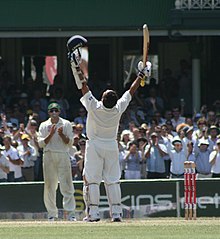
Tendulkar celebrates upon reaching his 38th Test century against Australia in the 2nd Test at the
SCG in 2008, where he finished
not out on 154
On the second day of the Nottingham Test (28 July 2007) Tendulkar became the third cricketer to complete 11,000 Test runs.
[92] In the subsequent One day series against England, Tendulkar was the leading run scorer from India
[93]
with an average of 53.42. In the ODI Series against Australia in
October 2007 Tendulkar was the leading Indian run scorer with 278 runs.
[94]
Tendulkar was dismissed seven times in 2007 between 90 and 100,
including three times at 99, leading some to suggest that he struggles
to cope with nerves in this phase of his innings. Tendulkar has got out
23 times between 90 and 100 in his international career.
[clarification needed] On 8 November 2007 he got out on 99 against Pakistan in an ODI at
Mohali to the bowling of
Umar Gul.
In the fourth ODI, he got out on 97 (off 102 balls with 16 fours) after
dragging a delivery from Gul on to his stumps, falling short of another
century in ODIs in 2007.
2007/08 tour of Australia
In the
Border-Gavaskar Trophy, 2007–08,
Tendulkar showed exceptional form, becoming the leading run scorer with
493 runs in four Tests, despite consistently failing in the second
innings. Sachin scored 62 runs in the first innings of the first Test at
the
MCG in
Melbourne, but couldn't prevent a heavy 337-run win for Australia. In the
controversial New Years Test at Sydney, Tendulkar scored an unbeaten 154 as India lost the Test. This was his third century at the
SCG, earning him an average of 221.33 at the ground. In the third Test at the
WACA cricket ground in
Perth,
Sachin was instrumental in India's first innings score of 330, scoring a
well compiled 71, as India went on to record a historic triumph at the
WACA. In the fourth Test at the
Adelaide Oval, which ended in a draw, he scored 153 in the first innings, involving in a crucial 126 run stand with
V.V.S. Laxman for the fifth wicket to lead India to a score of 282 for 5 from 156 for 4. He secured the
Player of the Match award.
In the One-Day International Commonwealth Bank Tri-Series involving
Sri Lanka and Australia, Tendulkar became the only batsman to complete
16,000 runs in ODIs. He achieved this feat against Sri Lanka on 5
February 2008 at the
Gabba in
Brisbane.
He started the CB series well notching up scores of 10, 35, 44 and 32,
but could not convert the starts into bigger scores. His form dipped a
bit in the middle of the tournament, but Tendulkar came back strongly in
India's must-win game against Sri Lanka at the
Bellerive Ovalin Hobart, scoring 63 off 54 balls. He finished the series with a match winning 117 not out off 120 balls in the first final,
[95] and 91 runs in the second final.
[96]
Home series against South Africa
South Africa toured in
March and April 2008 for a three-Test series. Tendulkar scored a five-ball duck in his only innings of the series;
[97]
he sustained a groin strain in the match and as a result was forced not
only to miss the second and third Tests, but also the tri-series
involving Bangladesh, the
2008 Asia Cup, and the first half of the inaugural season of the IPL.
[98]
Sri Lanka Series
Before the
touring Sri Lanka for three Test
in July 2008, Tendulkar needed just 177 runs to go past Brian Lara's
record of Test 11,953 runs. However, he failed in all six innings,
scoring a total of just 95 runs. India lost the series and his average
of 15.83 was his worst in a Test series with at least three matches.
[99]
Return to form and breaking the record
In the following ODI series against Sri Lanka, Tendulkar was
sidelined due to injury. However, during the following Australia tour of
India, he returned to fitness and form, scoring 13 and 49 in the first
test before making 88 in the first innings of the second test, thus
breaking the record for most number of Test runs held by Brian Lara. He
also reached the 12,000 run mark when he was on 61. He made a fifty in
the third test and 109 in the fourth, as India won the series 2–0 and
regained the Border-Gavaskar Trophy.
ODI and Test Series against England
Tendulkar was again out due to injury from the first three ODIs of a
7-match ODI series at home against England, but he made 11 in the fourth
ODI and 50 in the fifth, before the ODI series was called off due to
the Mumbai terror attacks, the scoreline being 5–0 to India.
England returned for a 2-match test series in December 2008, and in
the first test in Chennai, chasing 387 for victory, Tendulkar made 103
not out in a 163-run unbroken fifth wicket stand with Yuvraj Singh. This
was his third century in a fourth match innings, and the first which
resulted in a win. This was redemption for the Chennai Test of 1999 when
chasing 271 against Pakistan, Sachin had made 136 with severe back pain
and was out 17 runs short of the target, precipitating a collapse and a
loss by 12 runs. He dedicated this century to the victims of the Mumbai
terror attacks. Tendulkar failed in both innings in the second test,
India won the series 1–0.
2009–2010
In early 2009, India revisited Sri Lanka for five ODIs, as the
Pakistan series had been cancelled due to the security situation in
Pakistan and the attacks in Mumbai. Tendulkar failed to reach double
figures in any inning, before becoming injured.
India's next assignment was an away series against New Zealand,
consisting of three Tests and five ODIs. In the ODI series, Tendulkar
made a 163 not out in the third match, an innings ended by stomach
cramps that forced him to retire hurt. India made 392 and won easily and
won the series 3–1. Tendulkar made 160 in the first test, his 42nd Test
century, and India won. He made 49 and 64 in the second test and 62 and
9 in the third, in which India were prevented from winning by rain on
the last day. India won the series 1–0.
Tendulkar rested himself for the ODI tour of West Indies, but was
back for the Compaq Cup (Tri Series) between India, SL and New Zealand
in early September 2009. He made 46 and 27 in the league matches before
notching up 138 in the final, as India made 319 and won by 46 runs. This
was Tendulkar's 6th century in ODI finals and his third consecutive
score of over 50 in such finals. India has won all six times that
Tendulkar has made a hundred in an ODI final.
Tendulkar played just one innings in the ICC Champions trophy in
South Africa, scoring 8 against Pakistan as India lost. The next match
against Australia was washed out and he was out with food poisoning in
the third match against the West Indies, as India were eliminated.
Australia returned for a seven-match ODI series in India in October,
and Tendulkar made 14, 4, 32 and 40 in the first four games. In the
fifth match, with the series tied at 2–2, Australia amassed 350/4 in 50
overs. Tendulkar made his 45th ODI hundred, a 175 off 141 balls. Just
when it seemed that he would steer India to the large victory target, he
paddle-scooped debutant bowler
Clint McKay
straight to short fine leg, with India needing 19 from 18 balls with
four wickets left. The Indian tail collapsed, and they lost by 3 runs,
being all out for 347. During this match, Tendulkar also became the
first player to reach 17,000 ODI runs, and achieved his personal best
against Australia, as well as the third highest score in a defeat.
In the ODIs against Sri Lanka in 2009–10, Tendulkar scored 69, 43, 96
not out and 8, as India won 3–1.In the Test Series, he scored a 100 no
out in the first test, which was drawn, and 40 in the second and 53 in
the third test as India clinched innings victory in both tests. India
won the series 2–0.
[100]
Sachin rested himself for the ODI tri-series in Bangladesh in 2010.
In the Tests against Bangladesh, he made 105 not out and 16 in the first
test, and 143 in the second. India won 2–0.
In the
2-Test Series against South Africa,
Tendulkar made seven and 100 in the first test and 106 in the first
innings of the second test. In the course of the second 100 (his 47th
Test Hundred) he achieved several landmarks, in that he had scored four
hundreds in his last four matches and that the hundred against South
Africa in the first Test was the first at home against South Africa. The
century was also his hundredth score over 50 in International Test
cricket, moving him to 92 international hundreds (Tests and ODIs
combined). In the second match of the subsequent ODI series, Tendulkar
scored 200 not out to become the world's first person to score a double
century in ODI cricket.
[101]
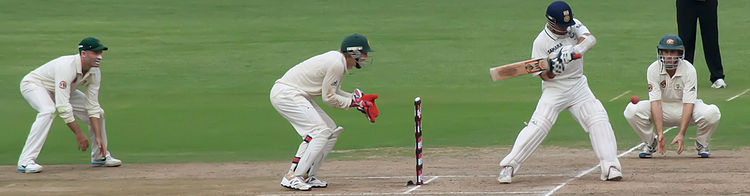

Tendulkar's shot to reach 14,000 Test runs. He was batting against Australia in October 2010.
2011 World Cup and after
From February to April, Bangladesh, India, and Sri Lanka hosted the
2011 World Cup.
Amassing 482 runs at an average of 53.55 including two centuries,
Tendulkar was India's lead run-scorer for the tournament; only
Tillakaratne Dilshan of Sri Lanka scored more runs in the 2011 tournament.
[102] India defeated Sri Lanka in the final.
[103]
Shortly after the victory, Tendulkar commented that "Winning the World
Cup is the proudest moment of my life. ... I couldn't control my tears
of joy."
[104]
- Tendulkar's results in international matches
|
|---|
India were due to tour the West Indies in June, although Tendulkar
chose not to participate. He returned to the squad in July for India's
tour of England.
[108]
Throughout the tour there was much hype in the media about whether
Tendulkar would reach his 100th century in international cricket (Test
and ODIs combined). However his highest score in the Tests was 91;
Tendulkar averaged 34.12 in the series as England won 4–0 as they
deposed India as the No. 1 ranked Test side.
[109][110]
The injury Tendulkar sustained to his right foot in 2001 flared up and
as a result he was ruled out of the ODI series that followed.
[109]
Tendulkar created another record on 8 November 2011 when he became the
first cricketer to score 15,000 runs in Test cricket, during the opening
Test match against the West Indies at the Feroz Shah Kotla Stadium in
New Delhi.
[111][112]
Ian Chappell
was not happy with Sachin's performance after India's tour of
Australia. He says that Sachin's quest for his 100th hundred has proved
to be a hurdle for the entire team and has hampered their performance on
the Tour of Australia. Former India World Cup winning captain and
all-rounder Kapil Dev has also voiced his opinion that Sachin should
have retired from ODI's after the World Cup. Former Australian fast
bowler, Geoff Lawson, has said that Sachin has the right to decide when
to quit although he adds that Tendulkar should not delay it for too
long.
[113]
The selection committee of BCCI expectedly included Sachin in the
national test squad for the upcoming series against New Zealand
commencing in August 2012.
[114]
100th international century
Tendulkar scored his much awaited 100th international hundred on 16 March 2012, at Mirpur against Bangladesh in the Asia Cup.
[115]
He became the first person in history to achieve this feat.
Incidentally, it was Tendulkar's first ODI hundred against Bangladesh.
He said "It's been a tough phase for me ... I was not thinking about the
milestone, the media started all this, wherever I went, the restaurant,
room service, everyone was talking about the 100th hundred. Nobody
talked about my 99 hundreds. It became mentally tough for me because
nobody talked about my 99 hundreds."
[116] Despite Tendulkar's century, India failed to win the match against Bangladesh, losing by 5 wickets.
[117]
Return To Ranji Trophy (2012)
After getting out bowled on 3 similar instances against the New
Zealand recently and hitting a slump in form, the master returned to
Ranji Trophy to get back some form ahead of the England Series at home,
in a match for Mumbai against Railways on 2 November 2012. All eyes were
on Tendulkar, who was playing his first Ranji Trophy match since 2009.
And he didn't disappoint smashing 137 off 136 balls with 21 fours and 3
Sixes, to take his team to 344 for 4 at stumps on day one.
[117]
However, because of a poor form in the first two Tests in the series
against England, and India being humiliated in the second match of that
series by 10 wickets on 26 November 2012,
[118] some people have started to question his place in the Indian team. A report by
The Hindustan Times said that Tendulkar had a discussion with the national chief selector
Sandeep Patil, in which he said that he would leave it to the selectors to decide on his future as he is not getting any runs.
[119] This speculation, however, was later considered to be false.
[120][121]
Indian Premier League and Champions League
Tendulkar was made the icon player and captain for his home side, the
Mumbai Indians in the inaugural
Indian Premier League Twenty20 competition in 2008.
[122] As an icon player, he was signed for a sum of US$1,121,250, 15% more than the second-highest paid player in the team,
Sanath Jayasuriya.
[123]
In 2010 edition of Indian Premier League, Mumbai Indians reached the
final of the tournament. Tendulkar made 618 runs in 14 innings during
the tournament, breaking
Shaun Marsh's
record of most runs in an IPL season. He was declared player of the
tournament for his performance during the season. He also won Best
Batsman and Best Captain awards at
2010 IPL Awards ceremony.
Sachin Tendulkar captained Mumbai Indians in 4 league matches of
second edition of the league. He scored 68 in the first match and 48
against Guyana. But Mumbai Indians failed to qualify for semifinals
after losing the initial two matches. Tendulkar scored 135 runs.
[124]
In the 2011 IPL, against
Kochi Tuskers Kerala,
Tendulkar scored his maiden Twenty20 hundred. He scored 100 not out off
66 balls. In 51 matches in the IPL Tendulkar has scored 1,723 runs,
making him the second-highest run-scorer in the competition's history.
[125]
Style of play

Tendulkar plays a wristy leg-side flick
Tendulkar is
cross-dominant: He bats, bowls and throws with his right hand, but writes with his left hand.
[126] He also practices left-handed throws at the nets on a regular basis.
Cricinfo columnist Sambit Bal has described him as the "most wholesome batsman of his time".
[1]
His batting is based on complete balance and poise while limiting
unnecessary movements and flourishes. He appears to show little
preference for the slow and low wickets which are typical in India, and
has scored many centuries on the hard, bouncy pitches in South Africa
and Australia.
[1]
He is known for his unique punch style of hitting the ball over square.
He is also renowned for his picture-perfect straight drive, often
completed with no follow-through. Straight drive is his favourite shot.
[127] In 2008
Sunil Gavaskar,
in an article he wrote in the AFP, remarked that "it is hard to imagine
any player in the history of the game who combines classical technique
with raw aggression like the little champion does".
[128]
Sir Donald Bradman,
considered by many as the greatest batsman of all time, considered
Tendulkar to have a batting style similar to his. In his biography, it
is stated that "
Bradman
was most taken by Tendulkar's technique, compactness and shot
production, and had asked his wife to have a look at Tendulkar, having
felt that Tendulkar played like him. Bradman's wife, Jessie, agreed that
they did appear similar."
[129][130]

Tendulkar at the crease, getting ready to face a delivery
Former Australian cricket team coach
John Buchanan voiced his opinion that Tendulkar had become susceptible to the short ball early in his innings because of a lack of footwork.
[131] Buchanan also believes Tendulkar has a weakness while playing left-arm pace.
[131]
He was affected by a series of injuries since 2004. Since then
Tendulkar's batting has tended to be less attacking. Explaining this
change in his batting style, he has acknowledged that he is batting
differently due to that fact that, firstly, no batsman can bat the same
way for the entire length of a long career and, secondly, he is a senior
member of the team now and thus has more responsibility. During the
early part of his career he was a more attacking batsman and frequently
scored centuries at close to a run a ball.
Ian Chappell, former Australian player, remarked in 2007 that "Tendulkar now, is nothing like the player he was when he was a young bloke".
[132]
Tendulkar has incorporated several modern and unorthodox strokes into
his repertoire in recent times, including the paddle sweep, the scoop
over short fine leg and the slash to third man over the slips' heads,
over the last seven or eight years. This has enabled him to remain
scoring consistently in spite of the physical toll of injuries and a
lean period in the mid-2000s. By his own admission, he does not bat as
aggressively as he did in the 90s and early 2000s, because his body has
undergone changes and cannot sustain aggressive shotmaking over a long
period. He is often praised for his ability to adapt to the needs of his
body and yet keep scoring consistently.

Tendulkar has taken 200 wickets across all three formats of the international game.
While Tendulkar is not a regular bowler, he can bowl
medium pace,
leg spin, and
off spin.
He often bowls when two batsmen of the opposite team have been batting
together for a long period, as he can often be a useful partnership
breaker. With his bowling, he has helped secure an Indian victory on
more than one occasion.
[133]
He has taken 200 international wickets - 44 in Tests, 154 in ODIs where
he is India's tenth highest wicket taker, and one wicket in
Twenty20 Internationals.
[134]
Controversies
Mike Denness incident
Main article:
Mike Denness and Indian cricket team incident
In India's 2001 tour of South Africa in the second
test match between
India and
South Africa at
St George's Park,
Port Elizabeth match referee
Mike Denness fined four Indian players for excessive appealing as well as the Indian captain
Sourav Ganguly for not controlling his team.
[135] Tendulkar was given a suspended ban of one game by Mike Denness in light of alleged
ball tampering. Television cameras picked up images that suggested Tendulkar may have been involved in cleaning the seam of the cricket ball.
[136] This can, under some conditions, amount to altering the condition of the ball. The match referee
Mike Denness found Sachin Tendulkar guilty of ball tampering charges and handed him a one Test match ban.
[137] The incident escalated to include allegations of racism,
[138]
and led to Mike Denness being barred from entering the venue of the
third test match. The ICC revoked the status of the match as a Test as
the teams rejected the appointed referee.
[139] The charges against Tendulkar and Sehwag's ban for excessive appealing triggered a massive backlash from the Indian public.
[140]
Ferrari import tax
In commemorating Tendulkar's feat of equalling
Don Bradman's 29 centuries in
Test Cricket, automotive giant
Ferrari invited Tendulkar to its paddock in
Silverstone on the eve of the
British Grand Prix on 23 July 2002, to receive a
Ferrari 360 Modena from the F1 world champion
Michael Schumacher.
[141] On 4 September 2002 India's then finance minister
Jaswant Singh wrote to Tendulkar telling him that the government will waive customs duty imposed on the car as a measure to applaud his feat.
[142]
However the rules at the time stated that the customs duty can be
waived only when receiving an automobile as a prize and not as a gift.
It is claimed that the proposals to change the law (Customs Act) was put
forth in Financial Bill in February 2003 and amended was passed as a
law in May 2003. Subsequently the Ferrari was allowed to be brought to
India without payment of the customs duty (
 1.13 crore (US$205,660)
 or 120% on the car value of
75 lakh (US$136,500)).
[143] When the move to waive customs duty became public in July 2003, political and social activists protested the waiver
[144] and filed a
PIL in the
Delhi High Court. With the controversy snowballing, Fiat India agreed to pay the import duty.
[145]
Fan following
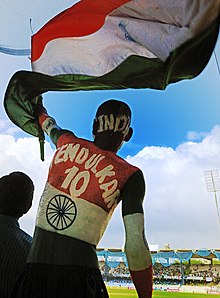 Sudhir Kumar Chaudhary
, a fan of Tendulkar who earned the privilege of tickets to all of India's home games
Tendulkar's entry into world cricket was hyped up by former Indian
stars and those who had seen him play. Tendulkar's consistent
performances earned him a fan following across the globe, including
amongst Australian crowds, where Tendulkar has consistently scored
centuries.
[65] One of the most popular sayings by his fans is "Cricket is my religion and Sachin is my God".
[146] Cricinfo mentions in his profile that "... Tendulkar remains, by a distance, the most worshipped cricketer in the world."
[147] During the Australian tour of India in 1998
Matthew Hayden said "I have seen God. He bats at no. 4 in India in Tests."
[148]
There have been many instances when Sachin's fans have done extreme
activities over Sachin's dismissal in the game. As per reports by many
Indian newspapers, a person hanged himself being distressed over
Sachin's failure to reach 100th century.
[149]
Some analysts have found that Sachin is the greatest ever cricketer
in the world surpassing Don Bradman, owing to his remarkable
accomplishments in both Tests and ODIs. At home in
Mumbai, Tendulkar's fan following has caused him to lead a different lifestyle.
Ian Chappell
has said that he would be unable to cope with the lifestyle Tendulkar
was forced to lead, having to "wear a wig and go out and watch a movie
only at night".
[132]
In an interview with Tim Sheridan, Tendulkar admitted that he sometimes
went for quiet drives in the streets of Mumbai late at night when he
would be able to enjoy some peace and silence.
[150] Tendulkar has a presence in the popular social networking site Twitter with the user name sachin_rt since May 2010.
[151]
Business interests
Tendulkar's immense popularity has led him to be an early pioneer in
India on cricket business dealings when he signed a record sports
management deal with Worldtel in 1995, the value of the deal being
30 crore (US$5.46 million) over five years.
[152] His next contract with WorldTel in 2001 was valued at
80 crore (US$14.56 million) over five years.
[153] In 2006, he signed a contract with
Saatchi and Saatchi's ICONIX values at
180 crore (US$32.76 million) over three years.
[154]
Tendulkar has opened two restaurants:
Tendulkar's[155] (
Colaba,
Mumbai) and
Sachin's[156] (
Mulund,
Mumbai) and
Bangalore. Sachin owns these restaurants in partnership with Sanjay Narang of Mars Restaurants.
In 2007, Tendulkar also announced a
JV
with the Future Group and Manipal Group to launch healthcare and sports
fitness products under the brand name 'S Drive and Sach'.
[157] A series of comic books by
Virgin Comics is also due to be published featuring him as a superhero.
[158]
Commercial endorsements
Sachin Tendulkar has been sponsored by several brands throughout his career including
Boost (1990–present),
[159] Pepsi (1992–2009),
[160] Action Shoes (1995–2000),
[161] MRF (1999–2009),
[162] Adidas (2000–10),
[163] Britannia (2001–07),
[164] Fiat Palio (2001–03),
[165] TVS (2002–05),
[166] ESPN Star Sports (2002–present),
[167] Sunfeast (2007–13),
[168] Canon (2006–09),
[169] Airtel (2004–06),
[170] Reynolds (2007–present),
[171] G-Hanz (2005–07),
[172] Sanyo BPL (2007–present),
[173] Toshiba (2010–present),
[174] Colgate-Palmolive,
[175] Philips,
[175] VISA,
[175] Castrol India (2011–12),
[176] Ujala Techno Bright
[177] and
Coca-Cola (2011–13)
[178]
He has also been a spokesperson for
National Egg Coordination Committee (2003–05),
[179] AIDS Awareness Campaign (2005)
[180] and Luminous India (2010–present)
[181]
Political career
In April 2012, Tendulkar accepted the
Rajya Sabha nomination proposed by the
president. He is the first active sportsperson and cricketer to have been nominated to the Rajya Sabha.
[182] Reactions to this decision included:
Sanjay Manjrekar
who said that he was "actually shocked by the story itself, first by
the nomination as it came without any warning. And that Sachin has
accepted it is even more shocking. When I visualise what Sachin could
possibly do after retirement, I thought something connected to cricket,
coaching and all that, may be some business or social activity. But
Rajya Sabha MP after retirement or even at this stage of career is
something that was not even in my wildest guess." MP and former
cricketer
Kirti Azad
said that the move was akin to an honourary degree on an eminent person
and said that "Why should he not be successful? Unlike a Lok Sabha MP,
he does not have to worry about his constituency and he could focus on
the topics related to sports. I'm confident he will do a good job."
Former Indian captain
Dilip Vengsarkar
reacted in saying that "so far, they were nominating persons from other
fields. Now that a sportsman has been nominated to the Rajya Sabha, a
good precedent has been set."
DNA
questioned if Tendulkar could handle the political system and was aware
of the issues, though it also said that he has now outlined in partisan
politics in choosing a party after the nomination followed a visit to
the head of the
Indian National Congress' residence in New Delhi
[183] at the behest of party MP
Sanjay Nirupam.
[184] The nomination was also made by the president, who is a member of the INC, in the same year as she faces
re-election. Actor
Sanjay Dutt,
who had also tried to become a MP, said that "it is an honour to be in
the Rajya sabha. I am a fan of Sachin. He is the pride and jewel of
India. But, I am not happy that he is a Rajya Sabha member. He should
have been the way he is." He was also said to have the support of
Amitabh Bacchan.
[185] His decision to be a MP was also criticised in some quarters: Former Indian captain
Ajit Wadekar
said that "hope[s Tendulkar] does not suffer the same fate as another
legend, Amitabh Bachchan, politics is a big game. He had only said he is
not going to retire soon. But, my fear is how will he divide his time
and responsibilities." Former member of the Indian
1983 Cricket World Cup team
Madan Lal
was also surprised, saying that "the kind of person Sachin is, we never
expected him to take up politics." The Maharashtrian party
Shiv Sena's MP
Sanjay Raut questioned the timing and asked "is Sachin being used to divert attention from the problems plaguing the Congress?" The
Communist Party of India's
Gurudas Dasgupta sad that "I welcome the decision to nominate Tendulkar, but at the same time when
Sourav is in his top form, his name, too, should have been considered."
[184] His current colleague
Harbhajan Singh said that he was "proud that Sachin is getting the honour. He deserves much more than that. May God bless him always."
[186] Anti-corruption campaigner Baba Ramdev said that the INC was using the nomination and Tendulkar's stature to boost its battered image through
series of scandals and
electoral defeats.
[187] Five-time
World Chess Champion,
Viswanathan Anand
said "I hope he (Tendulkar) enjoys his role and he is able to do it
very well. It's a big step for him and I think he will enjoy it".
[188] Former Indian football captain
Baichung Bhutia reacted neutrally saying a nomination of a sports candidate was a personal choice to accept.
On 2 May, Tendulkar was elected to seat number 103 in the Rajya Sabha.
[189]
He took the oath as a member of the Rajya Sabha on 4 June; however he
could not take the oath during the budget session due to the ongoing
IPL.
[190] "Cricket comes first," Tendulkar said when reporters asked whether he preferred cricket to parliament.
[191]
Sachin Tendulkar had been alloted 5 Tughlak Lane bungalow, a type VII
accommodation in Lutyen's zone in New Delhi. The accommodation was just
opposite to that of Rahul Gandhi's residence.
[192] However, he has politely turned down the offer.
[193]
Career achievements
Main articles:
Achievements of Sachin Tendulkar and
List of ODI Awards for Sachin Tendulkar
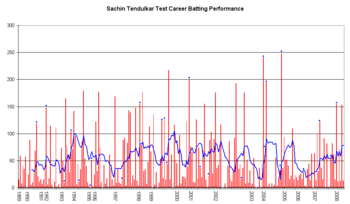
An innings-by-innings breakdown of Tendulkar's Test match batting career
up to February 2008, showing runs scored (red bars) and the average of
the last ten innings (blue line)
Sachin Tendulkar is the most prolific run scorer in one-day
internationals with 18,426 runs. With a current aggregate of 15,470 Test
runs, he surpassed
Brian Lara's previous record tally of 11,953 runs as the highest run scorer in test matches in the second Test of
Australia's
2008 tour of India in
Mohali.
[194][195] Tendulkar described "It is definitely the biggest achievement in 19 years of my career" on the day he achieved the record.
[196]
He also holds the record of highest number of centuries in both Test
(51) and ODI (49) cricket. (49). On 16 March 2012, Tenduklar scored his
100th international hundred.
[197] It came against
Bangladesh in the league matches of
Asia Cup 2012.
Throughout his career, he has made a strong impact on Indian cricket
and was, at one time, the foundation of most of the team's victories. In
recognition with his impact on sport in a cricket-loving country like
India, Tendulkar has been granted the
Rajiv Gandhi Khel Ratna,
Arjuna Award,
Padma Shri and
Padma Vibhushan by the
Government of India. He was also chosen as one of the five
Wisden Cricketers of the Year in 1997 and is ranked by the
Wisden 100 as the second best test batsman and ODI batsman of all time.
Tendulkar has also consistently done well in
Cricket World Cups. Tendulkar was the highest run scorer of the
1996 Cricket World Cup and
2003 Cricket World Cup. After his century against England during group stages of
2011 Cricket World Cup, he became the player to hit most number of centuries in
Cricket World Cups with six centuries and the first player to score 2000 runs in World Cup cricket.
[198][199]
Tendulkar has scored over 1000 runs in a calendar year in ODIs 7 times,
and in 1998 he scored 1894 runs, easily the record for the highest
number of runs scored by any player in a single calendar year for one
day internationals. Tendulkar is also one of the very few players who
are still playing in international cricket from the 1980s. On 24
February 2010, Tendulkar broke the previous world record for highest
individual innings in an ODI, and became the first male cricketer to
score a double-century in one-day cricket. He made 200 runs and broke
the previous record of 194 runs, jointly held by Pakistan opener
Saeed Anwar and Zimbabwe's
Charles Coventry.
[200]
He has been
Man of the Match 13 times in Test matches and
Man of the Series four times,
[201] out of them twice in the
Border-Gavaskar Trophy against
Australia. The performances earned him respect from Australian cricket fans and players.
[65] Similarly he has been
Man of the Match 60 times in One day International matches and
Man of the Series 14 times.He is the leading run-scorer and
century maker in
Test and
one-day international cricket.
[202][203][204] He is the first player to score a double century in Men's
ODI cricket.
[205][206] He also holds the world record for playing highest number of
Test and
ODI
matches. Tendulkar is the only cricketer to accomplish the feat of
scoring a hundred centuries in international cricket which includes 49
ODI and 51 Test centuries.
[207] He is also the only player to score fifty centuries in Test cricket,
[208] and the first to score fifty centuries in all international cricket combined. On 17 October 2008, when he surpassed
Brian Lara's
record for the most runs scored in Test cricket, he also became the
first batsman to score 12,000, 13,000, 14,000 and 15,000 runs in that
form of the game,
[194] having also been the third batsman and first Indian to pass 11,000 runs in Test cricket.
[209]
He was also the first player to score 10,000 runs in one-day
internationals, and also the first player to cross every subsequent
1000-run mark that has been crossed in ODI cricket history. In the
fourth Test of the Border-Gavaskar Trophy against Australia, Tendulkar
surpassed Australia's
Allan Border
to become the player to cross the 50-run mark the most number of times
in Test cricket history, and also the second ever player to score 11
Test centuries against Australia, tying with
Sir Jack Hobbs of England more than 70 years previously.
[210]
On 24 February 2010, Tendulkar became the first man to score a double
century (200*) in an ODI against South Africa. On 8 November 2011,
Tendulkar became the first batsman to score 15,000 runs in Test Cricket.
Individual honours and appreciations
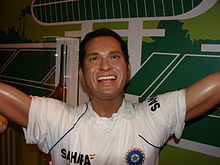
Tendulkar's Wax Statue in
Madame Tussauds, London
Centuries against different nations
Wisden Leading Cricketer in the World: 2010.
[211]ICC Award-Sir Garfield Sobers trophy for cricketer of the year 2010.
LG People's Choice Award: 2010.
Padma Vibhushan, India's second highest civilian award, 2008.
[212]ICC World Test XI: 2009, 2010, 2011.
ICC World ODI XI: 2004, 2007, 2010.Rajiv Gandhi Awards – Sports: 2005.
[213]Player of the tournament in
2003 Cricket World Cup.
Maharashtra Bhushan Award, Maharashtra State's highest Civilian Award in 2001.
[214]Padma Shri, India's fourth highest civilian award, 1999.
[215]Rajiv Gandhi Khel Ratna, India's highest honour given for achievement in sports, 1997–98.
[216]Wisden Cricketer of the Year: 1997.
Arjuna Award, by the Government of India in recognition of his outstanding achievement in sports, 1994.
[217]In October 2010, he was awarded for Outstanding Achievement in Sport and the Peoples Choice Award at
The Asian Awards in London.
[218]On 28 January 2011, he won the 'Castrol Indian Cricketer of the Year' award.
[219]'BCCI Cricketer of the Year' award on 31 May 2011.
[220]On 3 September 2010, he was made a Honorary
Group captain by the
Indian Air Force.
[221]On 11 June 2012, he was given Wisden India Outstanding Achievement award.
[222]Honorary Member of the Order of Australia, given by the
Australian government on 6 November 2012.
[223][224]
Philanthropy
Tendulkar sponsors 200 underprivileged children every year through
Apnalaya, a Mumbai-based NGO associated with his mother-in-law, Annabel
Mehta. A request from Sachin on Twitter raised
1.025 crore (US$186,550) through Sachin's crusade against cancer for the Crusade against Cancer foundation.
[225][226]
Sachin Tendulkar devoted all of nine hours to the 12-hour
Coca-Cola-NDTV Support My School telethon on 18 September 2011 that
helped raise
7 crore –
2 crore more than the target – for from the creation of basic
facilities, particularly toilets for girl students, in 140 government
schools across the country.
[227]
Biographies
Sachin Tendulkar has been the subject of various books. The following is the listing of books focused on Tendulkar's career:
Sachin: The Story of the World's Greatest Batsman by Gulu Ezekiel. Publisher: Penguin Global.
ISBN 978-0-14-302854-3[228]The A to Z of Sachin Tendulkar by Gulu Ezekiel. Publisher: Penguin Global.
ISBN 978-81-7476-530-7[229]Sachin Tendulkar-a definitive biography by Vaibhav Purandare. Publisher: Roli Books.
ISBN 81-7436-360-2[230]Sachin Tendulkar – Masterful by Peter Murray, Ashish Shukla. Publisher: Rupa.
ISBN 81-7167-806-8[231]If Cricket is a Religion, Sachin is God by Vijay Santhanam, Shyam Balasubramanian Publisher:
HarperCollins India ISBN 978-81-7223-821-6[232]Master Stroke: 100 Centuries of Sachin Tendulkar by Neelima Athalye. Publisher: Sakal Publications.
ISBN 978-93-80571-84-3[233]Dhruvtara, a book on cricket maestro Sachin Tendulkar, was launched as an audio book on Monday, 15 October 2012 to mark White Cane Day.
[234]
See also
List of International cricket centuries by Sachin TendulkarAchievements of Sachin TendulkarCollection of quotations related to Sachin TendulkarList of ODI awards for Sachin TendulkarList of One Day International cricket recordsIndian national cricket captainsPolitics and sports
Further reading
Murray, Peter; Shukla, Ashish (2002). Sachin Tendulkar: Masterful. Murray Advertising. ISBN 81-7167-806-8.
Notes
^ He scored 583 runs at an average of 67.77, and was the sixth highest run-scorer overall^ (Craig White,
although born in Yorkshire was the first player to be signed as an
overseas player by Yorkshire. He had to be listed as an overseas player
as he had already played for Victoria in Australia).^ He hit him for 6,4,0,6,6,6
References
^ a b c d e f g h Bal, Sambit. "Sachin Tendulkar—Cricinfo Profile". Cricinfo. Retrieved 14 December 2007.^ "biography".^ "Wisden 100 Best Performances in Cricket". Topendsports.com. 2012-09-01. Retrieved 2012-12-18.^ "Tendulkar second-best ever: Wisden". Rediff.com. Retrieved 27 November 2008.^ "Reliving a dream". The Hindu. 6 April 2011. Retrieved 6 April 2011.^ "Sachin Tendulkar named cricketer of the year". Retrieved 24 November 2010.^ India Today Online (5 April 2012). "Maharashtra govt recommends Bharat Ratna for Sachin Tendulkar". India Today (New Delhi).^ India Today Online (16 December 2011). "Government has made necessary changes in eligibility for Bharat Ratna award". India Today (New Dehli).^ "Rajya Sabha stint". Hindustan Times. 4 June 2012. Retrieved 4 June 2012.^ "Sachin Tendulkar set for return, all eyes on Laxman's future". The Times Of India. 9 August 2012.^ NDTV Correspondent (2012-12-05). "Sachin Tendulkar completes 34000 runs in international cricket | India vs England 2012 - News | NDTVSports.com". Sports.ndtv.com. Retrieved 2012-12-18.^ "Sachin's poor run continues. Should the Master Blaster call it a day? : SPORT - India Today". Indiatoday.intoday.in. 2012-12-07. Retrieved 2012-12-18.^ Firstpost. "Sachin Tendulkar completes 34000 international career runs! - Sachin Tendulkar Videos : Firstpost Topic - Page 1". Firstpost.com. Retrieved 2012-12-18.^ "Records | Combined Test, ODI and T20I records | Batting records | Most runs in career | ESPN Cricinfo". Stats.espncricinfo.com. Retrieved 2012-12-18.^ "Mysore University to honour Sachin with doctorate". The Times of India. 11 January 2011. Retrieved 24 February 2011.^ "RGUHS doctorate for Master Blaster". Deccan Chronicle. 20 February 2011. Retrieved 24 February 2011.^ "Reliance ICC Test Championship Batting Rankings". Retrieved 4 December 2012.^ "http://timesofindia.indiatimes.com/sports/cricket/series-tournaments/sachin-tendulkar--an-indian-icon/top-stories/Sachin-Tendulkar-nominated-for-ICC-Peoples-Choice-Award/articleshow/15311425.cms Sachin Tendulkar nominated for ICC People's Choice Award".^ "Tendulkar receives Order of Australia membership". Wisden India. 6 November 2012.^ Mangalore Today News Network – Sachin Tendulkar celebrates twenty glorious years of cricket^ Official Opus Website – Biography of Tendulkar^ India4u – Biography of Sachin Tendulkar^ Thani, L.; Mishra, R. (1999). Sensational Sachin. Diamond Pocket Books. p. 113. "His mother Rajni Tendulka worked in L.I.C."[ISBN missing]^ Related Topics: cricket, india, sports, sports players. "Sachin Tendulkar". Mahalo.com. Retrieved 2012-12-18.^ "38 special facts about Sachin Tendulkar - 3". Sports.in.msn.com. 2012-03-16. Retrieved 2012-12-18.^ "38 special facts about Sachin Tendulkar - 2". Sports.in.msn.com. 2012-03-16. Retrieved 2012-12-18.^ a b c d e "HTCricket.com: A special HTCricket section celebrating Sachin Tendulkar's 100th Test". Hindustantimes.com. Retrieved 2012-12-18.^ Baliga, Linah (1 April 2011). "Shivaji Park prays for famous son". The Times of India. Times News Network.^ Somak Sen (17 October 2008). "Sachin Tendulkar: The last word in cricket". Merinews. Retrieved 3 June 2009.^ Williams, Richard (15 May 1999). "Tendulkar's genius inspires awe". The Independent. Retrieved 17 February 2012.^ "Tendulkar's interview with BBC". The Indian Express. Retrieved 1 June 2008.^ Booth, Lawrence. "Strange innovations – Cricinfo.com". Cricinfo. Retrieved 3 August 2009.^ "A tale of two terrors". Cricinfo. Retrieved 1 June 2008.^ "Sachin Tendulkar, Sports Photo, Cricketing genius Sachin Tendu". Timescontent.com. 24 May 1995. Retrieved 21 December 2010.^ "Tendulkar Junior born yesterday". Cricinfo. Retrieved 1 June 2008.^ "Arjun Tendulkar included in MCA under-14 probables list". 26 June 2012.^ a b Personal Info' on Sachin Tendulkar^ a b Times of India – Tendulkar prays for Sai Baba, cancels birthday celebrations^ Deccan Herald – Tendulkar cancels birthday celebrations, prays for Sai Baba^ Indian Express – Sai Devotee Sachin^ Sai bhakt Sachin calls off birthday celebrations^ Vedamu – Arjuna Ranatunga's Article^ Zee News – Tendulkar pays homage to Sri Sathya Sai^ Deccan Herald – Sachin in tears while paying last respects to Sathya Sai Baba^ Hindustan Times – The master mourns his guru^ Youtube Video of Sachin crying at Prasanthi Nilayam – by TV9 Kannada News^ LiveIndia – Sachin Tendulkar^ ThatsCricket – Sachin offers prayers at Tirumala temple, Tirupathi^ Zee News – Tendulkar seeks divine blessings, visits Kali temple^ "Sachin Tendulkar factfile". espnstar.com. Retrieved 3 August 2009.^ "1988–89 Ranji season – Most Runs". Cricinfo. Retrieved 3 August 2009.^ "Rest of India v Delhi in 1989/90". Cricketarchive. Retrieved 3 August 2009.^ "Yorkshire players at Cricket Archive". Cricketarchive. Retrieved 1 June 2008.^ "Sachin Tendulkar". Cricket365.com. Retrieved 25 April 2012.^ "His last words: Donald George Bradman". Daily News and Analysis (India). 13 September 2009. Retrieved 11 March 2011.^ "First-Class Matches played by Sachin Tendulkar". Cricketarchive. Retrieved 3 August 2009.^ Andrew Miller and Martin Williamson (11 December 2007). "Eleven quircky debuts". Cricinfo. Retrieved 12 December 2007.^ a b "Sachin Tendulkar Timeline". Cricinfo. Retrieved 4 August 2009.^ "A suitable beginning – Tendulkar takes Qadir on". Retrieved 5 August 2009.^ "Cricket Records – India in Pakistan Test Series, 1989/90 – Most runs". Cricinfo. Retrieved 4 August 2009.^ "Batting and Fielding for India in Wills Challenge 1989/90". Cricketarchive. Retrieved 5 August 2009.^ "Test Batting and Fielding for India in India in New Zealand 1989/90". Cricketarchive. Retrieved 5 August 2009.^ "Batting and Fielding for India in Rothmans Cup Triangular Series 1989/90". Cricketarchive. Retrieved 5 August 2009.^ Otway, Graham. "Wisden – England v India 1990". Wisden Almanack. Retrieved 17 August 2009.^ a b c Saltau, Chloe (9 December 2007). "Tender touch". Melbourne: The Age Newspaper. Retrieved 12 December 2007.^ "Ind v NZ 27 March 1994 match report". Cricinfo. Retrieved 1 June 2008.^ "Cricket Records –
Written by - Aakash Kumar Verma.


 debate over whether he needs to be included in the 2007 Cricket World Cup squad, captain Dravid's insistence on his retention paved the way to being named in the world cup squad. However, despite this assurance, Sehwag's form has continued to decline, and he has now failed to pass 17 in his last seven games. India have won only two of those games.


